GGU-FOOTING: Settlement analysis
Settlement analyses are carried out according to DIN 4019. Once the program has determined the characteristic or allowable footing pressure for the proposed footing, the settlements are determined using these characteristic or allowable values. DIN 4019 Table 1 allows correction coefficients kappa to be taken into consideration for modelling settlements (see menu item "File/New").
The program calculates stresses and deformations according to the theory of elastic-isotropic half-space. Very comprehensive diagrams and tables were developed, particularly in the time before pocket calculators and personal computers were available. A bibliography of tables can be taken from DIN 4019. Please also see the article "Spannungsberechnung" ("Stress analysis") in the Geotechnical Engineering Handbook (1990; Fourth edition; chapter 1.7, Schultze/Horn, pp. 215 to 222). This also contains complete relationships for deformations and stresses below a rectangle in elastic-isotropic half-space (equations 8 to 10 and equations 14 and 15). The program is based on these relationships. If you recalculate the equations: "Artan" there denotes the inverse hyperbolic tangent (artanh), not the arctangent.
The stress relationships are only utilised for limiting depth calculations and for representation of stress distributions. For rectangular footings, the deformations are calculated directly from the relationships given in the Geotechnical Engineering Handbook. Numerical integration with associated loss of precision is therefore not necessary there. If a base tilt results when analysing a pad footing these relationships can no longer be used because the pressure zone is no longer rectangular. In this case, an analytical-numerical settlement analysis is required. For circular and annular footings, settlements are always calculated analytically-numerically: the pressure zone is divided into sub-areas, over which the solution for the elastic-isotropic half-space is integrated numerically.
Influence of Poisson's ratio nu
DIN 4019 permits two approaches for settlement analysis: one-dimensional integration of the strains εz = σz / E* (section 10.3.1), which does not include Poisson's ratio, and the solution for the elastic half-space using Young's modulus E and Poisson's ratio nu (section 10.2.2 with equation B.1). The program uses the second approach. The settlement is the integral over depth of the strain
εz = [σz − nu · (σx + σy)] / E
This results in the following:
- The vertical stress σz does not depend on nu. The stress distributions displayed and the limiting depth therefore do not change when you change nu.
- nu enters twice: directly as a factor on the lateral stresses, and via the lateral stresses σx and σy themselves, which depend on nu in the half-space.
- For nu = 0.0 both approaches are identical. The program then gives the same result as integrating σz / Es over depth.
- With a fixed Young's modulus E (check box "Compute Young’s modulus from Es and nu" deactivated) the settlement decreases as nu increases. With a fixed constrained modulus Es (check box activated) it generally increases. The exception are wide footings on thin layers (footing width from about 20 times the layer thickness down to the limiting depth): there the settlement first decreases as nu increases, by up to 30 % up to 0.4, and only rises again for higher values. What the check box does is described under Define soils.
- Stresses are determined in a homogeneous half-space. Restraint of lateral strain by stiffer adjacent layers is not modelled.
The note on equation B.2 in DIN 4019 states that, for points within the loaded area, assuming nu = 0 together with the modulus E* is sufficiently accurate for practical applications.
The limiting depth can be defined in three different ways:
- with a fixed, user-defined value
- as a multiple of the footing width
- as the depth at which the total vertical stress exceeds the overburden stress by x% (as a rule 20%).
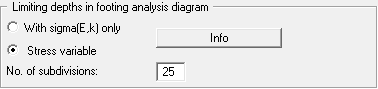
The settlement curves in the footing analysis diagram are attained from the footing pressure by linear interpolation. Thus, analysis using the x%-criteria only takes place for the maximum footing pressure of each footing width. However, if you open "Edit/Analysis options" menu item and activate the "Stress variable" check box, the limiting depth is calculated for a number of stresses (here for 25 stresses).