GGU-RETAIN: Double-bounded surcharges (active side)
If two bounded surcharges are defined as follows: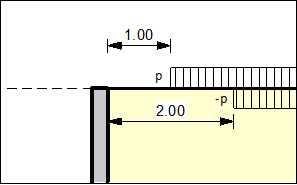
- Bounded surcharge 1:
begins at x = 1,00 m and has the value p. - Bounded surcharge 2:
begins at x = 2,00 m and has the same value as surcharge 1 but with a negative sign
(see the explanation under “Theoretical principles: Bounded surcharges (active side)").
A double-bounded surcharge, which acts because of p at x = 1.00 to x = 2.00, is thus defined as the result of earth pressure analysis. However, the graphics are not satisfactory and may be irritating for an examiner. Double-bounded surcharges were therefore introduced.
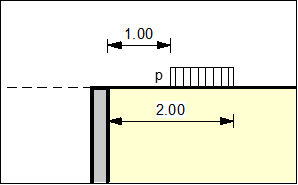
The same result is achieved as for the definition provided by the first figure above but with improved graphics, provided the control parameter is set to 1.0 (see “"Double-bounded surcharges" menu item”). For smaller values the linear component of the negative surcharge is only partly adopted, and the earth pressure from the double-bounded surcharge is then greater.
The area loads described in the Theoretical principles are based on different assumptions for the resulting earth pressure (including a different approach for the earth pressure coefficient in stratified ground), so the definition of a double-bounded surcharge does not provide the same result as an equivalent area load.