GGU-FIELDCAPACITY: Preface
GGU-FIELDCAPACITY determines the available field capacity (nFK) and the air capacity (LK) of soils according to the German soil mapping guideline, Bodenkundliche Kartieranleitung, 5th edition (KA5). It works from the grain-size distribution, the dry bulk density and the humus content of a sample. Typical uses are assessing topsoils in agriculture and verifying restoration and cultivation layers, for example in landfill construction.
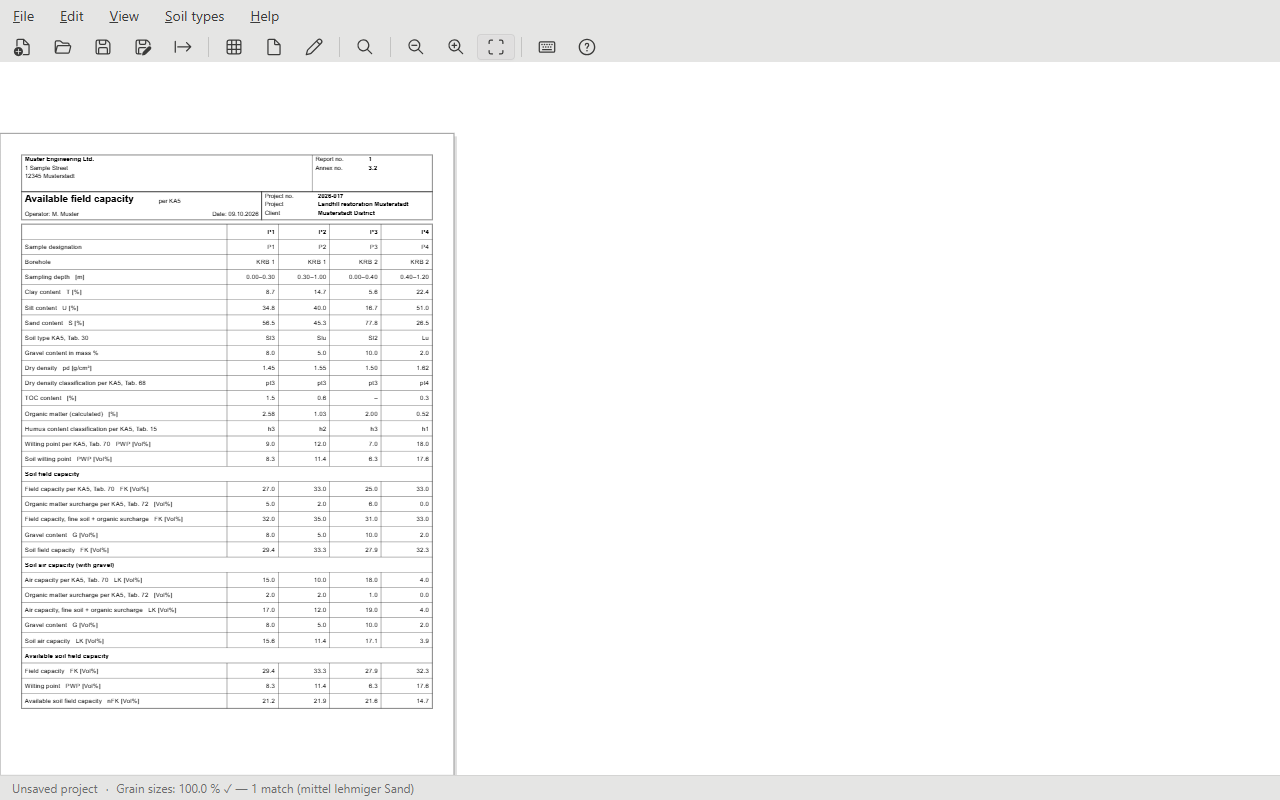
The result is an A4 evaluation sheet with up to six samples side by side, which you export as a PDF and attach to your report.
Workflow at a glance
- If the samples are in GGU-CONNECT, take them over from there first: Exchanging data with GGU-CONNECT. Taking them over replaces the open project, including the company header.
- Enter the project data and the company header: Project and company.
- Enter or complete the samples with grain sizes, dry bulk density and TOC or humus content: Entering samples.
- Check the evaluation sheet and adjust the rows shown if needed: Evaluation sheet.
- Save the project and export the sheet as a PDF or print it: Files and PDF export. For samples from GGU-CONNECT, hand the results back with GGU-CONNECT / Export data to GGU-CONNECT.
How the program derives the parameters from your input is described in Calculation according to KA5.
Program version
This manual describes GGU-FIELDCAPACITY from version 0.10. Evaluation according to the 6th edition of the guideline (KA6) is in preparation and cannot be selected in the program yet.
Project files
A project is saved as a file with the extension .ggufk. It contains all samples, the project and company data including the logo, and the selection of rows on the evaluation sheet. Program settings such as language or appearance are not part of the project; they apply to your installation. See Files and PDF export and Program settings.